What Happens When Your AI Assistant Gets Worse
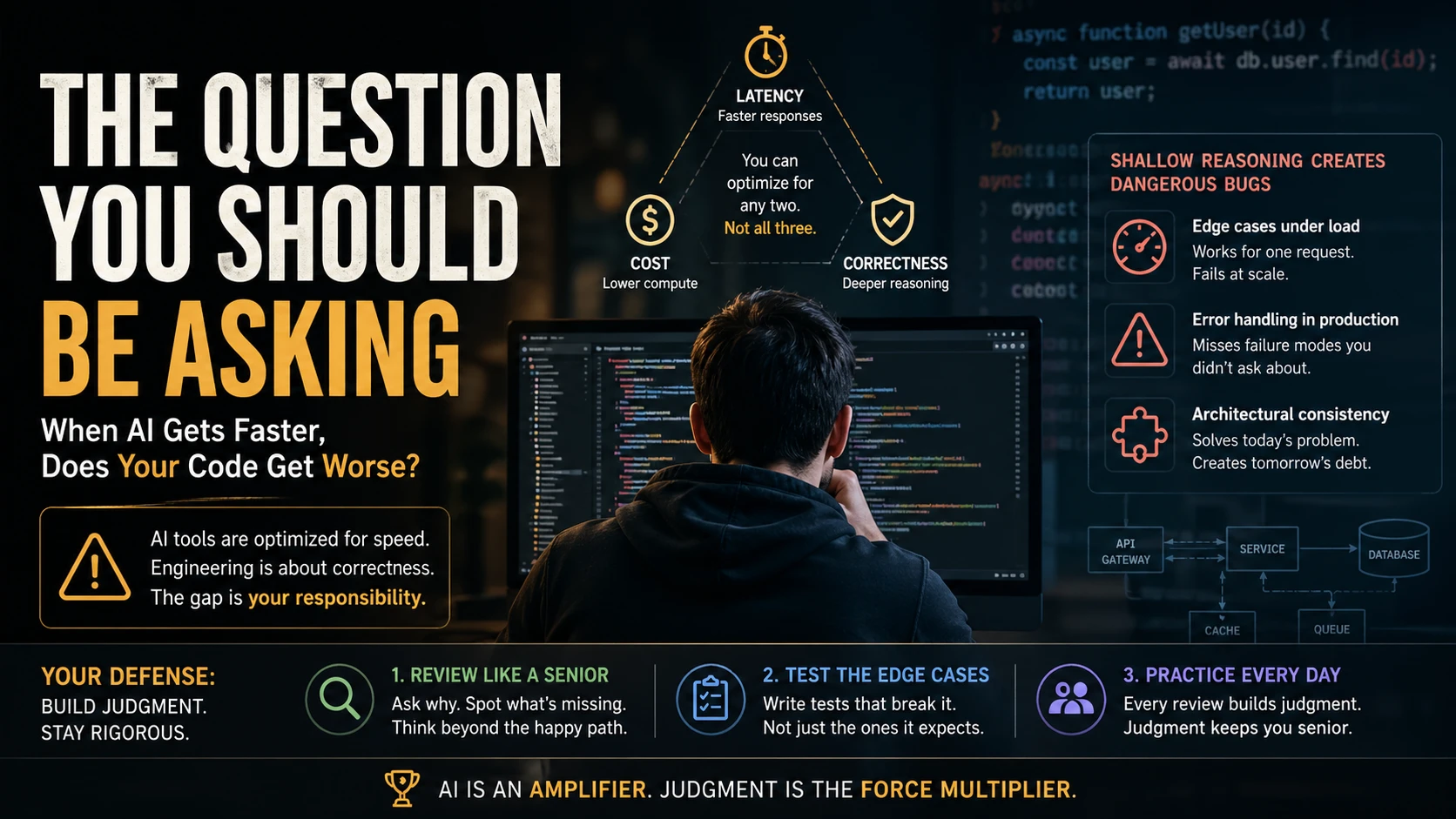
The Question You Should Be Asking
On April 11, 2026, Stella Laurenzo, an AI director at AMD, published a detailed analysis showing that Claude Code had declined significantly in quality over the previous month. The analysis was based on 6,800+ sessions and 234,000 tool calls. The patterns were unmistakable: shallow reasoning, incomplete thinking, solutions that looked correct but skipped critical logic.
The tweet gained 68,900 views, 1,054 likes, and sparked 85 technical replies in less than 24 hours. Engineers responded with their own observations. Same degradation. Same pattern. Same hollowed-out reasoning.
How would you know if your AI assistant stopped thinking deeply? What would you catch? What would you miss?
If your answer is “I don’t know,” you are not alone. Most developers have grown dependent on AI tools without building the independent verification skills that protect them when those tools degrade. When your copilot gets lazier, does your code get worse? If you cannot answer that question with confidence, you have a judgment gap.
What Anthropic Actually Changed
The official response from Anthropic team members clarified that they had optimized Claude’s performance by removing thinking summaries. No model degradation, they said. No “nerfing.” Just a latency improvement that happened to also hide what the model was thinking about.
This is where the tension reveals itself: when you optimize for latency, you are optimizing for speed. When you optimize for speed, you optimize for cost. And when you optimize for cost, you optimize for the kind of reasoning that finishes quickly, not the kind that finishes correctly.
This is not conspiracy. It is not malice. It is how systems work. A model that thinks deeply about edge cases takes longer. A model that generates code quickly misses the details. You can have one or the other. You cannot reliably have both, especially at scale across thousands of API calls per second burning GPU compute that costs money every millisecond the inference runs.
One engineer in the thread made the critical observation: “You cannot rely on the model to self-check. If the model is getting lazier at reasoning, it is also getting lazier at reviewing its own output.”
That line should haunt you. Because if you have been trusting AI to review its own code, to catch its own mistakes, to think through the edge cases it might have missed, to verify that its solution fits the architectural patterns established in your codebase, you have been building a dangerous habit.
The Dangerous Kind of Mistake
Most developers think of bugs as failures that are obvious. Syntax errors. Runtime crashes. Test failures. These are the easy bugs. They shout.
The dangerous bugs are the ones that look correct. They pass your initial tests. They get code review approval. They make it to production, where they fail in ways you did not predict. Years from now, when someone reads this code and tries to add a feature, they will discover it was built on a shaky foundation.
Shallow reasoning produces exactly these bugs. Not because the AI is broken. Because it stopped thinking through scenarios that require deep reasoning.
Consider this category of mistakes where shallow AI reasoning becomes dangerous:
Edge cases under load. The AI generates a solution that works for the happy path. It handles one user, one request, one data point. But the logic does not scale. It does not account for concurrency. Under load with thousands of simultaneous requests, it fails in ways that are not immediately obvious from reading the code. The mistake is not a syntax error. It is an incomplete mental model of the problem.
Error handling in production. The AI generates code that handles the error path it was explicitly asked about. But it misses the broader failure scenarios. What happens when a database connection times out? What happens when an external API returns a 503? What happens when a message queue is full? The code was not built to think about the full spectrum of failure modes, so it does not handle them.
Architectural consistency. The AI generates a solution that solves the immediate problem. But it contradicts patterns established elsewhere in the codebase. It introduces a new abstraction where an existing one should be used. It works in isolation but creates long-term maintenance burden because it does not fit the architectural vision the team is building. Months later, you notice three different ways of solving the same problem because AI did not know the established pattern.
These are not syntax errors. They are judgment failures. And you cannot expect an AI tool that was optimized for speed to catch them, especially if the optimization involved removing the mechanisms for deep reasoning.
Why Your Engineering Judgment Is Now Your Only Defense
You cannot fix the AI industry’s optimization incentives. You cannot control whether Anthropic, OpenAI, Google, or Anthropic prioritizes latency over reasoning depth. You cannot make tool providers choose correctness over cost. Model providers live in markets with competitive pricing pressure. Latency matters. Cost matters. Your code quality matters less to their incentive structure than their margin per inference call.
But you can build the skills that make you immune to tool degradation.
The engineers who survived the Claude regression without incident were not the ones who panicked about model quality. They were not the ones who switched to a different tool. They were the ones who never fully outsourced their judgment to the tool in the first place. They reviewed code. They tested aggressively. They asked “why did the model generate this pattern?” and did not accept “because it was the first thing the model thought of” as a sufficient answer.
What this looks like in practice:
First, code review becomes non-negotiable. You read code generated by AI the same way you would read code written by a junior developer who you trust to write correct syntax but who might miss architectural patterns. You look for incomplete solutions. You spot areas where the reasoning stopped too early.
A simple example: you see a function that retrieves data from a database and transforms it for display. The AI generated it. It works. But did the AI think about what happens when the database returns no results? Is there a null check? What about when the query times out? Is there a timeout configuration? What if the transformation fails partway through? The AI did not think about these things. You need to think about them.
Code review is not just a quality gate. It is where you learn to see incomplete reasoning. It is where you develop the judgment to ask “what did this person miss?” When you practice code review regularly, you build the pattern recognition that lets you spot when an AI tool has taken a shortcut.
Second, you practice thinking about edge cases before you write tests. This is the reversal that matters. Most developers write code, then write tests to verify the code works. But when you are verifying code written by an AI tool, you should write tests that target the edge cases you worry about, not the edge cases the AI suggests.
If you think the code might fail under concurrent load, write a test that creates concurrent requests. Do not wait for the AI to tell you to test for concurrency. If you think the code might break with empty input, that is the first test you write. This habit, thinking about how things break before you run them, is what separates developers who catch shallow reasoning from developers who trust it.
Third, you keep a habit of reading test names before you read the code. Test names tell you what the developer (or AI) thought was important to verify. If the test names only cover the happy path, something is wrong. Real code has many paths. If the test suite only validates one path, you have incomplete reasoning somewhere. The tests should tell a story about what can go wrong. If the story is too simple, the reasoning was shallow.
The Original Case Study: What the Regression Revealed
The Claude regression thread revealed something more valuable than just “the model got worse.” It revealed how degradation happens invisibly until someone measures it with precision.
Stella Laurenzo had concrete data: 6,800 sessions compared month-to-month, 234,000 individual tool calls analyzed, measurable difference in reasoning depth on common patterns. The analysis was specific. It was not “Claude feels slower” or “Claude seems less helpful.” It was “the model is skipping reasoning steps in these measurable ways on these specific patterns.”
What struck me about the engineering responses was how many people said variations of: “I noticed this and I thought I was just using the tool wrong. I figured I needed to write better prompts or ask the model to think step-by-step.”
That is the real danger of invisible degradation. When a tool gets worse slowly, you do not notice. You adapt. You assume you are the problem. You adjust your expectations downward. You start accepting incomplete solutions as “good enough” because that is what the tool is producing. The baseline shifts without you realizing it.
The only defense is external verification that does not depend on the tool staying good. Tests that fail when the reasoning is shallow. Code review that catches incomplete patterns. Architectural thinking that spots when a design violates established principles. Automated checks that surface when consistency breaks.
None of these require the AI tool to stay high quality. They require you to stay rigorous. They require you to maintain your standards independent of what the tool is producing.
The Trade-Off That Explains Everything
Every system has constraints. For AI models, the major constraints are inference latency, compute cost, and correctness. You can optimize for any two of these. But optimize all three simultaneously? That is not possible at scale.
flowchart TD
    classDef pivot fill:#1A1610,stroke:#E5A649,stroke-width:2px,color:#E5A649
    classDef safe fill:#122416,stroke:#7A9B76,stroke-width:1.5px,color:#A8D0A4
    classDef danger fill:#2A1510,stroke:#D97656,stroke-width:2px,color:#E8937A
    classDef dangerEnd fill:#351812,stroke:#D97656,stroke-width:2.5px,color:#D97656,font-weight:bold

    A{"AI model constraints"}:::pivot
    A -->|"Optimize latency + cost"| B["Correctness suffers"]:::dangerEnd
    A -->|"Optimize latency + correctness"| C["Cost explodes"]:::danger
    A -->|"Optimize cost + correctness"| D["Slow responses"]:::safe

    linkStyle 0 stroke:#D97656
    linkStyle 1 stroke:#E5A649
    linkStyle 2 stroke:#7A9B76
Anthropic chose: optimize for latency and cost. This means less reasoning per inference. Faster responses. Lower infrastructure bill. The correctness side had to give.
This is not unique to Claude. Every model provider faces the same pressures. Every AI assistant is being optimized in directions that trade off against the reasoning depth that catches edge cases and incomplete thinking.
Understanding this trade-off is valuable because it means you can predict where your tools will fail. The places where reasoning depth matters most are the places where tool-generated code will be most unreliable. Edge cases. Concurrent systems. Error scenarios. Architectural consistency.
These are the exact trade-offs that software engineering asks you to navigate when you design systems. Correctness versus speed. Thorough thinking versus pragmatism. The same reasoning applies to understanding your tools.
What You Should Do Right Now
This is not a “panic about AI” post. It is not a “stop using AI” post. AI tools are genuinely useful when you verify their output. The problem is verification without judgment. The problem is trust without verification.
Here are three concrete practices that protect you starting today.
First, establish a practice of reviewing your own AI-generated code the way you would review code from a junior developer you are trying to teach. Do not just read it. Ask questions. “Why did the code choose this abstraction?” “What happens if this condition is never true?” “Is this the pattern we use elsewhere, or did the AI invent a new one?” “What did the AI not think about?” Force yourself to think about why each line is there and what scenarios the developer (or AI) failed to consider.
Second, write your edge case tests before you ask yourself if the code is correct. Think about the ways this code could fail. The things it was not explicitly told to handle. The scenarios that are not in the requirements but exist in the real world. Write tests for those scenarios first. Then see if the code passes. This reverses the normal testing flow and forces you to think like someone trying to break the code, not someone trying to verify it works.
Third, treat code review as part of your practice discipline, not just a gate to merge. Every code review you do teaches you what questions to ask. Every piece of AI-generated code you evaluate teaches you which kinds of reasoning tools skip. If you review 100 pieces of AI-generated code and notice the pattern that shallow AI reasoning misses error handling, that is valuable judgment. When you write code yourself or evaluate new AI-generated code, you remember that lesson. This is how you build the mental models that protect you from tool degradation.
These habits feel slow. They feel like they contradict the promise of AI productivity. But they are the only way to actually get productivity. Because the productivity is not in the code the AI generates. It is in the code that survives in production six months later when your requirements change and your junior developer tries to extend it.
Conclusion
What the Claude regression really proved: you cannot outsource your engineering judgment to tools. You can use tools to amplify your judgment. You can use AI to generate code faster. You can use models to help you think through problems. But the responsibility for evaluating that code, for thinking through the scenarios the tool did not think about, for maintaining architectural consistency across the codebase, for knowing when the tool has taken a shortcut. That responsibility stays with you.
And that is actually good news.
Because when the tools degrade, when they trade reasoning for speed, when they optimize for cost at the expense of correctness, the developers who have the deepest engineering judgment are the ones who thrive. They are not dependent on the tool staying good. They are dependent on their own ability to evaluate and verify.
The developers who will struggle are the ones who grew so dependent on AI that they forgot how to think independently. The ones who stopped doing code review because the AI was handling it. The ones who stopped writing tests because the tool seemed reliable. The ones who never built the judgment in the first place.
Dev-drill teaches this skill through deliberate practice. The exercises force you to think through code like an experienced engineer. To spot incomplete reasoning. To evaluate trade-offs. To understand why certain patterns matter in production systems. The engineers who practice code review regularly, who work through complex reasoning problems deliberately, who build habits around testing and verification, are the ones who will survive any tool degradation. Their AI assistants make them more productive. But if the AI gets worse, they do not fall apart. They catch the mistakes. They maintain quality. They keep building.
The time to build this judgment is not after your tools fail. It is now. Before the degradation happens. Before you have already shipped code that passed a shallow reasoner’s verification. The habits you build today protect you tomorrow.
Sources
Ready to sharpen your engineering skills?
Practice architecture decisions, trade-off analysis, and system design with AI-powered drills. 5 minutes a day builds judgment that compounds.
Start Free Trial7-day free trial. Cancel before it ends and pay nothing.