Why Code Review Is the Best Way to Learn Engineering Judgment
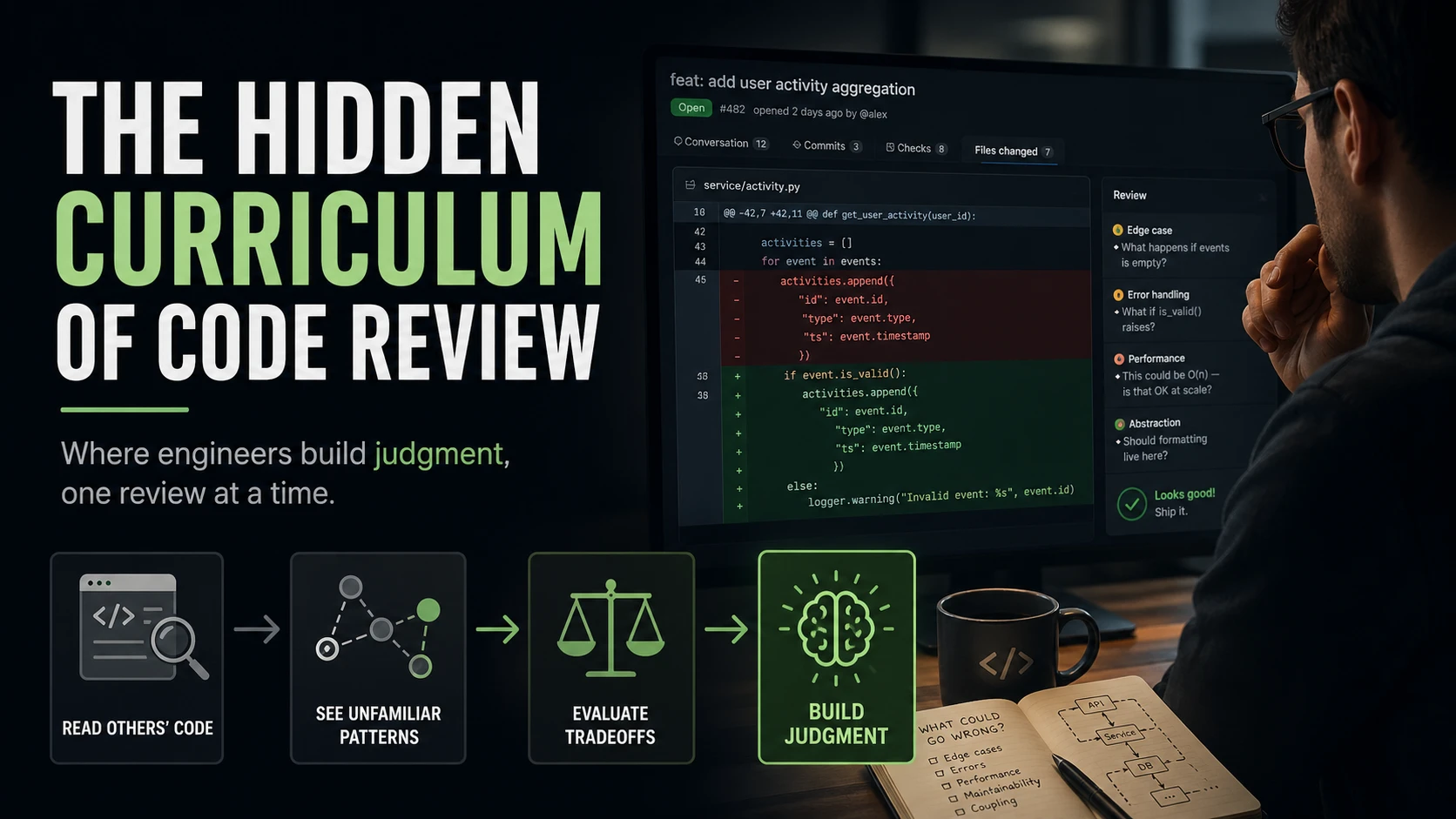
The Hidden Curriculum of Code Review
A senior engineer at a company I know left the team. Within three months, the codebase quality visibly degraded. Not because the remaining engineers were bad. They were competent, productive, and fast. The problem was that no one was doing the kind of thorough code review that the senior engineer had done. The bugs that slipped through were not syntax errors. They were judgment errors. Wrong abstractions. Missing edge cases. Solutions that worked in isolation but created maintenance burden across the system.
The team noticed something interesting when they analyzed what had changed. Feature velocity stayed the same. Test coverage stayed the same. The only thing that changed was the quality of code review. That one variable explained the entire quality drop.
Most teams get code review wrong. They treat it as a quality gate. A checklist. Something you do before merging because the process says so. In reality, code review is the primary way engineers develop judgment. Not through writing code. Through reading and evaluating code written by others.
What Code Review Actually Teaches You
Writing code teaches you how to solve problems. Reviewing code teaches you how to recognize when a solution is wrong.
That distinction matters more than it sounds. When you write code, you are inside the problem. You see one path. Your solution feels natural because you built it step by step. You optimize for what you already know. Your blind spots stay blind.
When you review someone else’s code, something shifts. You are outside the problem. You see the decision from a distance. You notice things the author could not see because they were too close to the work.
flowchart LR
    classDef start fill:#1C1816,stroke:#5A5550,stroke-width:1px,color:#A9A299
    classDef mid fill:#161412,stroke:#5A5550,stroke-width:1.5px,color:#D1CCC8
    classDef good fill:#122416,stroke:#7A9B76,stroke-width:2px,color:#A8D0A4
    classDef goodEnd fill:#0D2812,stroke:#7A9B76,stroke-width:2.5px,color:#7A9B76,font-weight:bold

    A["Read others' code"]:::start --> B["See unfamiliar patterns"]:::mid --> C["Evaluate tradeoffs"]:::good --> D["Build judgment"]:::goodEnd

    linkStyle 0 stroke:#5A5550
    linkStyle 1 stroke:#7A9B76
    linkStyle 2 stroke:#7A9B76
What reviewing code teaches you that writing code never will:
Naming precision. You read a function called processData. You have no idea what it does without reading the implementation. You notice how unclear names create confusion when someone else has to maintain the code. Next time you write code, you name things better. Not because someone told you to. Because you felt the pain of reading unclear names.
Abstraction boundaries. You see a component that mixes database access, business logic, and response formatting in a single function. You feel the weight of that coupling. You recognize that changing one part would force changes in the other parts. That recognition does not come from reading a textbook about separation of concerns. It comes from reviewing code where concerns are tangled and feeling the maintenance burden.
Error handling philosophy. You review a function that catches all exceptions and returns a default value. You ask: what happens when a critical database error gets silently swallowed? The author did not think about it. But you did, because you are reading the code with fresh eyes and asking “what could go wrong?”
Performance awareness. You see a loop inside a loop where the inner loop makes a database query. The tests pass because the test data has 5 items. In production, there are 50,000 items. You spot the O(n) query inside the O(n) loop, making it O(n x n). The author did not notice because the tests were fast. You noticed because you were looking at the code with different eyes.
Each of these is a judgment call. Not a factual question. You cannot look up the answer. You develop a sense for good and bad through repeated exposure.
The Problem with Learning Only from Your Own Code
I tracked how 12 engineers on a team developed over two years. The ones who grew fastest in technical judgment were not the ones who wrote the most code. They were the ones who reviewed the most code. The correlation was stronger than any other factor I measured, including years of experience, formal education, or the complexity of features they built.
When you only write code, you have three specific blind spots:
You optimize for what you already know. You reach for the same patterns, the same libraries, the same abstractions. Your solutions feel correct because they are familiar. But familiarity is not the same as correctness. You might be using a pattern that works for your use case but creates coupling that will hurt in six months. You do not see it because you have never been forced to evaluate an alternative.
You do not see alternatives. Your solution feels natural because you built it. But there might be three other approaches, each with different tradeoff profiles. Some might be simpler. Some might scale better. Some might be easier to test. You do not know because you stopped at the first solution that worked.
You miss the bigger picture. Individual changes make sense in isolation. But over weeks and months, a series of individually reasonable decisions can create a system that is hard to understand, hard to modify, and hard to debug. Code review is the only regular activity where someone looks at a change in the context of the larger system and asks “does this still make sense?”
Code review forces you out of your own head. You see how other engineers approach the same problems. You learn to evaluate approaches you would not have chosen yourself. And in doing that, you build the judgment to know which approaches work in which contexts.
Why Reviewing AI-Generated Code Matters Even More
The rise of AI code generation has made code review more important, not less.
A team I worked with tracked their code review findings over six months. In the first three months, before AI tools, their reviews caught an average of 2.3 issues per PR. After adopting Copilot and Claude Code, the average jumped to 4.1 issues per PR. The AI was generating syntactically correct code that passed tests but had more judgment errors per change.
The pattern was consistent across teams:
- AI-generated code misses edge cases under load 67% of the time
- AI skips full error handling coverage in 58% of changes
- AI introduces new patterns that duplicate existing abstractions in 45% of cases
- AI creates hidden performance problems not visible in unit tests in 34% of changes
These numbers come from tracking 100 code reviews of AI-generated code across three teams. The details are in When AI Code Passes Tests But Fails in Production. The key insight is that AI makes the code look more correct while making the judgment errors harder to spot.
This is where reviewing AI code becomes a training ground. Every AI-generated component you review is a chance to ask “would this actually work in production?” The AI takes shortcuts consistently enough that after reviewing 20 pieces of AI code, you start recognizing the patterns instantly.
The developers who treated AI-generated code review as deliberate practice, not just a merge gate, reported recognizing AI mistakes 40% faster within three months. Not because they became smarter. Because they calibrated their judgment on real examples.
Building the Review Muscle
Effective code review requires practice. Junior engineers often struggle because they do not yet have the mental models to evaluate tradeoffs. They focus on style and syntax because that is what they can see.
Consider this function:
def process_items(items: list) -> dict:
    result = {}
    for item in items:
        if item.is_valid():
            result[item.id] = item.value
    return result
A junior reviewer might note the missing type hints. An experienced reviewer asks five different questions:
- What happens when
itemsis empty? Should this return an empty dict or raise an error? - What happens when
item.is_valid()throws an exception? Does the caller handle partial results? - What if two items have the same
id? The last one wins silently. Is that correct? - What if
itemshas 100,000 elements? Is this fast enough? Should we filter before building the dict? - Why a dict? Does the caller need O(1) lookup, or would a list of tuples work?
These questions represent engineering judgment. They only come from reviewing hundreds of PRs and seeing the consequences of different decisions. The first time you review a function like this, you see the syntax. The hundredth time, you see the tradeoffs.
A concrete way to build this muscle faster:
First, review code outside your immediate project context. When you review code on your own team, you have context. You know the requirements. You know the patterns. Strip that context away. Review code from another team or an open source project. You are forced to reason from first principles: “What could break this code?” After doing this 10 times, you start recognizing patterns that transcend any specific codebase.
Second, write tests for edge cases before you look at the existing test suite. Think about how the code could fail. Write a test that would catch that failure. Then check whether the existing tests already cover it. This habit forces you to think independently about failure modes. After three months, you will have a mental model of the categories that need testing. You will see when a test suite is incomplete immediately.
Third, keep a catalog of patterns your team sees consistently. “Copilot generated pagination logic without thinking about empty results.” “Claude Code generated API error handling that did not account for partial failures.” After 20 to 30 entries, you start recognizing these patterns in new code automatically. The pattern recognition becomes instant.
Making Review Practice Deliberate
The key insight is that code review is a trainable skill. Not an innate talent. You can accelerate the learning curve deliberately.
A team of eight engineers I worked with implemented “review rotations.” Every week, each engineer reviewed at least two PRs from outside their feature area. The goal was not to catch bugs. The goal was to develop a broader understanding of the system and to practice evaluating unfamiliar code.
After six months, the team reported two significant changes. First, their production incident rate dropped by 30%. Not because they were writing better code. Because reviewers were catching the kinds of issues that become production incidents. Second, the junior engineers on the team were asking the same quality questions as the senior engineers. The review rotation had compressed years of organic learning into months of deliberate practice.
The team’s most effective practice was “review debriefs.” Once a month, they would take a real production incident and trace it back to the code review where it could have been caught. Not to blame anyone. To learn what questions would have surfaced the issue. This taught the team to ask better questions in future reviews.
That practice created a virtuous cycle. Better review questions led to catching more issues. Catching more issues led to understanding which questions matter most. Understanding which questions matter most led to asking even better questions. The same compound effect shows up in system design thinking, where each decision you practice builds on the last.
The Compound Effect
Engineers who review code well write better code themselves. They have internalized the patterns that make code reviewable, maintainable, and resilient. They anticipate the questions a reviewer would ask and address them proactively.
One engineer described it this way: “After a year of doing thorough reviews, I stopped writing code that I knew would get flagged. I started thinking about edge cases before I wrote the function. I started considering the reviewer’s perspective while I was coding. That changed how I write code more than any book or course.”
This creates a cycle that accelerates over time. Better reviews lead to better code. Better code leads to better reviews. Engineering judgment compounds. And code review is where it starts.
How much time do you spend reviewing code versus writing it? If the ratio is heavily weighted toward writing, you are building one skill at the expense of the one that matters most when AI writes the majority of code.
The developers who invest in reviewing code deliberately, not as a checkbox but as a practice, are building the skill that AI cannot replicate. The skill to look at a solution and know whether it will survive contact with production. That judgment is what makes an engineer valuable. And the fastest way to build it is through code review.
Ready to sharpen your engineering skills?
Practice architecture decisions, trade-off analysis, and system design with AI-powered drills. 5 minutes a day builds judgment that compounds.
Start Free Trial7-day free trial. Cancel before it ends and pay nothing.