System Prompts Beat Model Quality
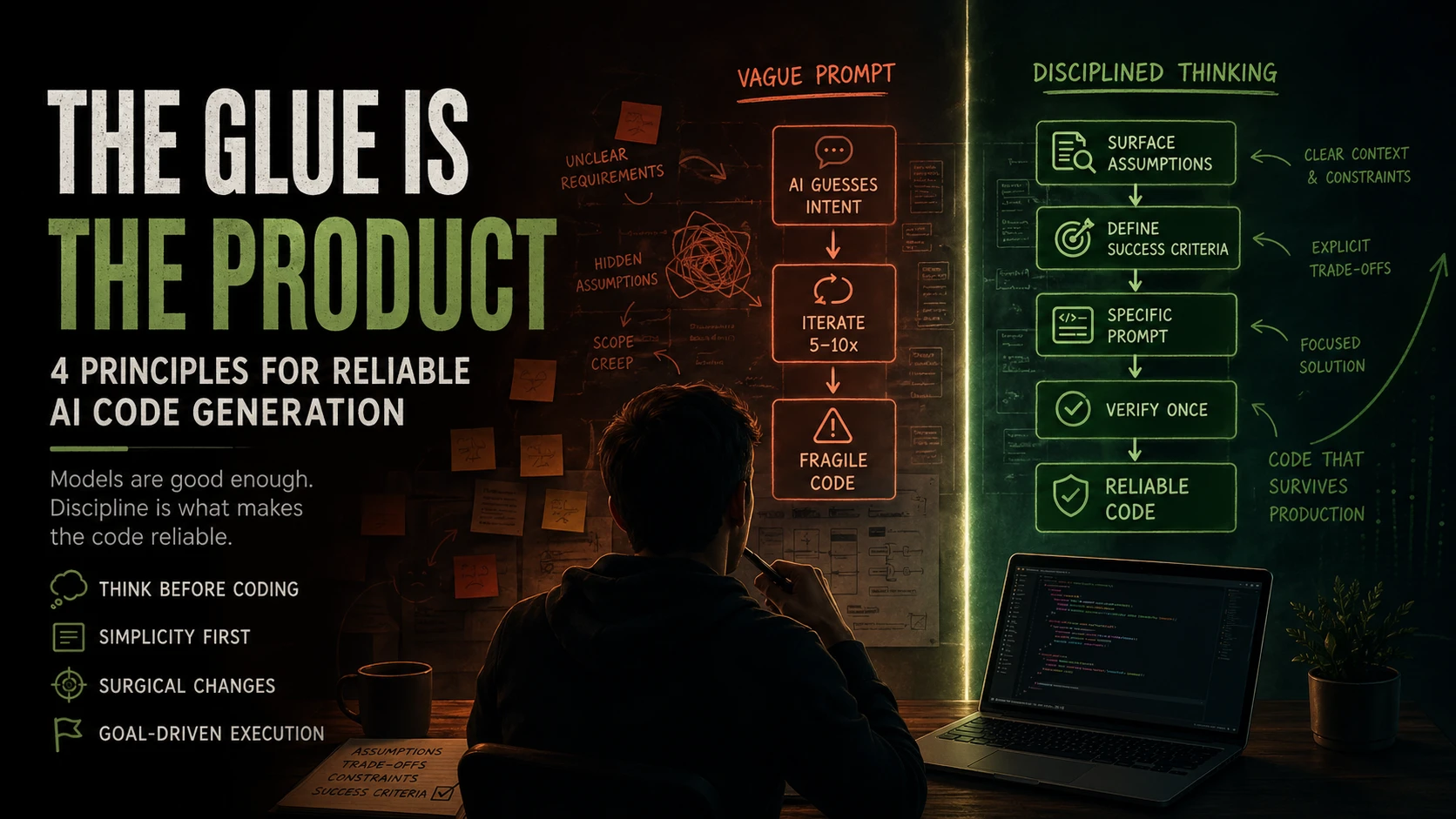
Last week, the number one trending repository on GitHub was not a framework. It was not a library. It was a single text file. CLAUDE.md. Forty-four thousand developers starred it in seven days.
Most of them were probably looking for a hack. A quick trick to make their AI assistant generate better code. What they found was something more uncomfortable: a mirror.
The file contains four principles. Andrej Karpathy distilled them from years of observing how LLMs fail in production. The striking part is what the principles are NOT about. They do not talk about better models. They do not ask for newer AI, smarter algorithms, or larger training data. They talk about how you think before you ask the AI to code. They talk about engineering discipline.
This signals a shift that most developers have not noticed yet. The bottleneck is no longer the model. The bottleneck is how you constrain it.
The Model Is Not the Bottleneck
The AI you are using right now is probably good enough. Claude, Copilot, the latest open source models. Their capabilities are not the problem. The problem is that most developers are using them wrong.
Think about how you use AI code generation today. You probably write a vague prompt (“build a payment API”), the AI generates code, you iterate on it until it works, then you ship it. That workflow feels fast. It also ships fragile code. Not obviously broken code. Code that works in isolation and then fails in subtle ways six months later.
The developers who get reliable code from AI do something different. They think like code reviewers before they ask the AI to code. They ask themselves: What assumptions am I making? What tradeoffs exist? What could go wrong? What are my success criteria? Only after answering those questions do they tell the AI what to build.
flowchart TD
    classDef start fill:#1C1816,stroke:#5A5550,stroke-width:1px,color:#A9A299
    classDef bad fill:#221410,stroke:#C06040,stroke-width:1.5px,color:#E09070
    classDef badHot fill:#2E1610,stroke:#D97656,stroke-width:2px,color:#F0A080
    classDef badEnd fill:#351812,stroke:#D97656,stroke-width:2.5px,color:#D97656,font-weight:bold
    classDef good fill:#101E14,stroke:#5A8A58,stroke-width:1.5px,color:#8AB888
    classDef goodHot fill:#122416,stroke:#7A9B76,stroke-width:2px,color:#A8D0A4
    classDef goodEnd fill:#0D2812,stroke:#7A9B76,stroke-width:2.5px,color:#7A9B76,font-weight:bold

    V1["Vague prompt"]:::start --> V2["AI guesses intent"]:::bad --> V3["Iterate 5–10x"]:::badHot --> V4["Fragile code"]:::badEnd
    D1["Surface assumptions"]:::start --> D2["Define success criteria"]:::good --> D3["Specific prompt"]:::goodHot --> D4["Verify once"]:::goodHot --> D5["Reliable code"]:::goodEnd

    linkStyle 0 stroke:#C06040
    linkStyle 1 stroke:#D97656
    linkStyle 2 stroke:#D97656
    linkStyle 3 stroke:#5A8A58
    linkStyle 4 stroke:#7A9B76
    linkStyle 5 stroke:#7A9B76
    linkStyle 6 stroke:#7A9B76
The difference is not the model output. The difference is the thinking before the model runs.
One team I know works on backend infrastructure. They were getting consistent issues with AI-generated database migration code. The migrations ran fine locally but failed in production under load. After switching to disciplined prompts, explicitly stating constraints like “must run in under 10 seconds on a 50GB table, no full table scans,” the problem disappeared. Same model. Different thinking. The AI was capable all along. It just needed guardrails.
This is what the Karpathy repository is signaling. The glue is the product. Not the model. The scaffolding around the model is where the real work happens.
Four Principles for Reliable AI Code
The four principles are not novel individually. Senior engineers have been practicing them for years. What makes them powerful is that they expose exactly where AI fails when discipline is missing.
Principle 1: Think Before Coding
This means: surface your assumptions before asking the AI to code.
Most developers skip this step. They have a problem. They want code. They ask the AI. The AI makes a guess about what you meant based on incomplete information. Then you spend three iterations clarifying.
Here is the disciplined approach: Before writing a prompt, ask yourself what assumptions you are making about the context. Make the AI articulate tradeoffs instead of just presenting a solution. Ask clarifying questions instead of letting the AI guess.
Example. Vague prompt: “Build a caching layer for our database queries.”
Disciplined prompt: “Build a caching layer with these constraints: We use PostgreSQL with frequently-updated product data. Cache hits are more important than fresh data (stale-by-5-minutes is acceptable). Memory is limited (max 2GB heap on production). The current issue is that 40% of our queries are duplicates within 1-minute windows. Present three approaches with tradeoffs around memory, freshness, and hit rate. Ask clarifying questions about: (1) What data changes frequency should we consider? (2) Are there queries we should never cache? (3) What is our budget for false negatives (serving stale data)?”
The second prompt takes 30 seconds longer to write. The AI output is more aligned with reality. You save hours in iteration.
This principle also catches model degradation. If your system prompt is clean and specific, you notice when the AI starts taking shortcuts. If your prompt is vague, you never know if the AI got lazier or you just were not specific enough.
Principle 2: Simplicity First
AI tends to over-engineer. It sees a problem and adds solutions for problems that do not exist yet.
You ask for a function that validates an email. AI returns a function that validates email, but also includes logging, optional retry logic, error tracking, and extensibility for future validators. That extra code did not exist before. You did not ask for it. You did not need it. And it becomes a maintenance burden.
The disciplined approach: Tell the AI explicitly to minimize. Minimum code that solves the problem. Nothing more. If you need logging later, you add it intentionally. If you need extensibility, you refactor for it when the need is clear.
I worked with a team that had this problem. Their AI-generated code always included “what if” scenarios. A database query included optional caching. A form handler included optional analytics. A validation function included optional internationalization. None of it was needed. All of it broke. When they switched to “solve exactly this problem, no more,” the code became more readable and more reliable. Same AI model. The difference was discipline.
The reason this matters is subtle. Overcomplicated code looks impressive. It looks professional. It looks like someone thought ahead. In reality, it creates options you did not choose, complexity you do not understand, and maintenance burden that compounds.
Principle 3: Surgical Changes
This one catches production bugs that sneak in silently.
You tell the AI: “Fix the bug in this function.” The AI fixes the bug. But it also notices that the adjacent function could be more efficient. So it refactors that too. It sees an error message that could be better. So it changes that. It sees a variable name that is not perfect. So it renames it.
Now your change set touches code you never intended to touch. The tests pass because the changes are individually reasonable. But in production, one of those adjacent changes interacts with something you did not see. And the system breaks.
flowchart TD
    classDef neutral fill:#161412,stroke:#5A5550,stroke-width:1.5px,color:#D1CCC8
    classDef pivot fill:#1A1610,stroke:#E5A649,stroke-width:2px,color:#E5A649
    classDef safe fill:#122416,stroke:#7A9B76,stroke-width:1.5px,color:#A8D0A4
    classDef danger fill:#2A1510,stroke:#D97656,stroke-width:1.5px,color:#E8937A
    classDef win fill:#0D2812,stroke:#7A9B76,stroke-width:3px,color:#7A9B76,font-weight:bold
    classDef lose fill:#351812,stroke:#D97656,stroke-width:3px,color:#D97656,font-weight:bold

    Bug["Bug in fetchUser()"]:::neutral --> Fix{"AI fixes it"}:::pivot
    Fix -->|"Disciplined"| Clean["Only that function changed"]:::safe --> Safe["Ship safely"]:::win
    Fix -->|"Undisciplined"| Cascade["Adjacent code also changed"]:::danger --> Risk["Subtle production breakage"]:::lose

    linkStyle 0 stroke:#5A5550
    linkStyle 1 stroke:#7A9B76
    linkStyle 2 stroke:#7A9B76
    linkStyle 3 stroke:#D97656
    linkStyle 4 stroke:#D97656
AI makes these orthogonal changes without asking because it is optimizing for “make this better.” It does not understand the cost of surprise changes. This is where code review discipline matters most, because you can catch these adjacent changes before they ship. The pattern is so common that you might recognize it in why AI gets frontend wrong, where AI changes styling alongside a logic fix, introducing cascading failures.
The discipline: Tell the AI explicitly. “Fix only the bug in the fetchUser function. Do not change anything else. Do not refactor. Do not optimize. Do not rename. Do not touch any adjacent code.” When the AI wants to make adjacent changes, that is a signal for human review, not a sign that the AI is being helpful.
Principle 4: Goal-Driven Execution
This principle separates reliable code from fragile code.
Fragile instruction: “Make the API fast.”
Reliable instruction: “The API must respond in under 200ms for the 95th percentile of requests, measured over a 24-hour production window, when handling 1000 requests per second, across all current supported browsers. If it cannot meet this, surface the specific bottleneck.”
The first instruction is vague. The AI will make a guess about what “fast” means. It might add caching. It might optimize database queries. It might do all of it. You will not know what “success” looks like until you measure it.
The second instruction is clear. The AI knows exactly what success means. It can self-check. It can present tradeoffs: “I can hit 200ms with in-memory caching, but it will use 500MB of RAM” or “I can hit 200ms by optimizing the database query, but it will add 5 seconds to the nightly analytics job.”
Clear success criteria make AI output predictable. Vague success criteria make AI output a surprise. This connects directly to what happens when AI code passes tests but fails in production, because vague success criteria lead to incomplete test coverage.
Why The Glue Is the Product
The GitHub phenomenon, 44,000 stars for a CLAUDE.md file, signals that developers are discovering something critical. The model quality matters. The system prompt matters more.
What we are observing in teams that ship reliable AI code:
- They invest time in system prompts before they write code
- They treat prompts like code: they version them, they test them, they refine them
- They notice when the model degrades because their prompts are specific enough to expose it
- They ship fewer iterations of bad code because they caught problems before the AI started writing
If you are iterating on AI output ten times before it is right, you are not using AI correctly. The problem is not the model. The problem is your prompt.
This is not a critique. It is a diagnosis. Most developers have been trained to treat AI as a write-it-and-iterate tool. Type a prompt, get code, fix it. Repeat. The shift that is happening is treating AI as a constrain-it-and-verify tool. Think deeply, write a clear spec, get code, verify it works.
The difference feels like it adds time upfront. In reality, it compresses the total time from idea to production because there are fewer bad iterations and fewer production surprises.
The gap between “code that works in isolation” and “code that survives contact with production” is not filled by better models. It is filled by better thinking before the model runs. And that thinking looks like what happens when your AI assistant gets worse. When you have clean prompts and clear criteria, degradation becomes visible immediately.
The Engineering Judgment That AI Replaces and Doesn’t Replace
What AI is genuinely good at: pattern recognition at scale, boilerplate generation, implementation details once the direction is clear, remembering library APIs you forgot, suggesting variations you did not think of.
What AI consistently misses: understanding your system’s failure modes, knowing what “good” means in your specific context, architectural decisions that require tradeoffs, recognizing when a simpler solution exists, knowing when to push back on a requirement instead of implementing it directly.
The gap between these is real. If you cannot articulate success criteria clearly, AI cannot achieve them. If you have not thought through tradeoffs, AI will make arbitrary choices. If you do not understand your system deeply, you cannot verify whether AI’s code is correct.
This is where most teams get stuck. They want AI to reduce thinking. But thinking is exactly what separates good code from fragile code. AI amplifies thinking. It does not replace it.
The developers who thrive are those who use AI as a thinking tool. Before they ask the AI to code, they think like a code reviewer. They ask hard questions. They surface assumptions. They define success. Then they use AI to implement precisely that vision. This mindset directly connects to AI code generation and engineering judgment, where the real value of AI is revealed through the lens of judgment, not capability.
Conclusion
The narrative around AI and development has been stuck on model quality. Bigger models. Better models. Smarter reasoning. That story is over. The frontier is not there anymore.
The new frontier is discipline. The developers who win in 2026 are not those who type prompts fastest. They are those who think hardest before they invoke the AI.
Stop optimizing for faster prompts. Start optimizing for better prompts. Invest time in thinking before you tell the AI what to do. Make your success criteria explicit. Force yourself to articulate tradeoffs. Ask clarifying questions instead of letting the AI guess.
This is the engineering judgment that AI cannot automate. And it is exactly what separates developers who thrive with AI assistance from those who get left behind.
This skill compounds over time. Every prompt you write carefully teaches you something about what works and what does not. Every production incident traceable to vague prompts teaches you what clear looks like. Every time you catch the AI making an adjacent change you did not ask for, you get better at writing prompts that prevent it.
This is a skill you can build through deliberate practice. Through writing prompts that are clear enough to catch problems. Through learning from mistakes. Through thinking like a reviewer before you ask the AI to code.
That is exactly what development is about. Not the code. The thinking behind the code.
Sources
Ready to sharpen your engineering skills?
Practice architecture decisions, trade-off analysis, and system design with AI-powered drills. 5 minutes a day builds judgment that compounds.
Start Free Trial7-day free trial. Cancel before it ends and pay nothing.